dinsdag 14 december 2010

Daring Cooks december 2010: Poach to perfection!


Jenn and Jill have challenged The Daring Cooks to learn to perfect the technique of poaching an egg. They chose Eggs Benedict recipe from Alton Brown, Oeufs en Meurette from Cooking with Wine by Anne Willan, and Homemade Sundried Tomato & Pine Nut Seitan Sausages (poached) courtesy of Trudy of Veggie num num.

I chose to make the eggs benedict, i was intrigued bij the idea of poaching eggs. But luckily it was'nt as difficult as i thought. The tips helped me a lot(fresh eggs are a must).
Served them with hollandaise sause on an english muffin(see recipe on my site)
Thanks Jenn and Jill for the great challenge!


Notes:
Poaching an egg is not very difficult technique-wise, it really is all about the timing and there are a few tricks that can help.


• Make sure to use the freshest eggs possible. Farm-fresh eggs will make for the best poached eggs. Old eggs will have a harder time with the whites spreading out all over the place when you place the egg in the water.

• Adding a bit of vinegar or acidic agent to your water will help stabilize the eggs and cook the whites faster, and keeping your water just below boiling point (about 190F) will help keep the fragile eggs from all the boiling bubble action rupturing the eggs. Also make sure to salt your poaching water well.

• The other main key to success is to crack your egg into a small bowl first, taking care not to break the yolk. Then it becomes easy to gently slide the entire egg into the water for the poaching process. Some people will also suggest swirling the poaching liquid into a bit of a vortex before sliding the egg in, in order to help keep the egg whites together. I’ve found it works fine whether or not you do this step.

• A poached egg is done when the whites are fully cooked and the yolk has just started to solidify but is still runny when you cut it open – usually three minutes. It’s ok to go a little longer though depending on your desired firmness. I like mine so the edges of yolks are cooking but the inside is still runny, so I usually let them go 30s longer.

• You can poach eggs ahead of time (about a day). Just immerse them in ice water after poaching, and then keep them in a bowl of water in the fridge. When you are ready to use them, place them in hot (not boiling) water until they are warmed through.

Mandatory Items: To use the technique of poaching an egg (or vegan substitute) in either one of the recipes listed below or your own creative take on the challenge. But whatever you do MUST involve the technique of poaching.

Variations allowed: Three recipes involving poaching are provided. Two that involve poaching eggs, and one that poaches seitan sausage to be vegan friendly. If you have not made eggs benedict or oeufs en meurette before, we really encourage you to try one of the listed recipes. However, if dietary restrictions lead you in a different direction, you are already a pro at those recipes, or just have something waiting to burst from your creative hat, we would love to see what poached egg dishes you come up with!

The link to Veggie Num Num’s seitan sausage recipe includes instructions for creamy polenta and tomato sauce, but feel free to use whatever recipes to accompany the sausages that you like, or none at all. I made my own polenta and some tomato sauce I canned earlier this summer, and it was fabulous, but this sausage would be good in so many preparations.

Preparation time:
Eggs Benedict: 20 minutes
Oeufs en Meurette: 60 – 90 minutes
Homemade Sundried Tomato & Pine Nut Seitan Sausages: 80 minutes to prepare the sausages; 30 minutes more if you make the polenta and tomato sauce and fry the sausages.

Equipment required:
Generally for poaching eggs you need:
• Large shallow pan
• Small bowl (for cracking eggs into)
• Large slotted spoon for lifting out poached eggs
• Timer

For Eggs Benedict:
• Double boiler (for the hollandaise)
• Alternatively a saucepan and heat proof mixing bowl that is large enough to sit on top
• Toaster or oven for toasting English muffins
• Frying pan for cooking bacon
• Thermos, carafe, or bowl (in which to keep the hollandaise warm)

For Oeufs en Meurette:
• Large shallow pan/pot for poaching
• Medium saucepan for sautéing, and then for frying the croûtes
• Paper towels

For Homemade Sundried Tomato & Pine Nut Seitan Sausages:
• Deep sauté pan or stock pot
• Small and large mixing bowls
• Food processor (optional)
• 4 pieces of cheesecloth (30 x 30 cm) (see note)
• 8 pieces of kitchen twine (8 in. each)

Eggs Benedict
Serves 4

Ingredients
4 eggs (size is your choice)
2 English muffins*
4 slices of Canadian bacon/back bacon (or plain bacon if you prefer)
Chives, for garnish
Splash of vinegar (for poaching)

For the hollandaise (makes 1.5 cups):
3 large egg yolks
1 tsp. (5 ml) water
¼ tsp. (1 ¼ ml/1½ g) sugar
12 Tbl. (170 g/6 oz.) unsalted butter, chilled and cut in small pieces º
½ tsp. (2 ½ ml/3 g) kosher salt
2 tsp. (10 ml) freshly squeezed lemon juice
Pinch cayenne pepper (optional)
* for gluten free, use gluten free English muffins or bread of your choice
º for dairy free, use a dairy free margarine

Directions:

1. Fill a medium saucepan halfway with water and bring to a simmer.

2. Cut the chilled butter into small pieces and set aside.

3. Whisk egg yolks and 1 tsp. (5 ml) water in a mixing bowl large enough to sit on the saucepan without touching the water (or in top portion of a double boiler). Whisk for 1–2 minutes, until egg yolks lighten. Add the sugar and whisk 30 seconds more.

4. Place bowl on saucepan over simmering water and whisk steadily 3–5 minutes (it only took about 3 for me) until the yolks thicken to coat the back of a spoon.

5. Remove from heat (but let the water continue to simmer) and whisk in the butter, 1 piece at a time. Move the bowl to the pan again as needed to melt the butter, making sure to whisk constantly.

6. Once all the butter is incorporated, remove from heat and whisk in the salt, lemon juice, and cayenne pepper (if using).

7. Keep the hollandaise warm while you poach your eggs in a thermos, carafe, or bowl that you’ve preheated with warm water.

8. If the water simmering in your pan has gotten too low, add enough so that you have 2–3 inches of water and bring back to a simmer.

9. Add salt and a splash of vinegar (any kind will do). I added about a tablespoon of vinegar to my small saucepan (about 3 cups of water/720 ml of water), but you may need more if you’re using a larger pan with more water.

10. Crack eggs directly into the very gently simmering water (or crack first into a bowl and gently drop into the water), making sure they’re separated. Cook for 3 minutes for a viscous but still runny yolk.

11. While waiting for the eggs, quickly fry the Canadian/back bacon and toast your English muffin.

12. Top each half of English muffin with a piece of bacon. Remove the eggs with a slotted spoon, draining well, and place on top of the bacon. Top with hollandaise and chopped chives, and enjoy!


Oeufs en Meurette
Serves 8

If you wish to halve this recipe, make sure to adjust your large shallow pan size accordingly so that you have enough depth for poaching your eggs. The poached eggs and the meurette sauce can be made up to a day in advance. Just take care store the poached eggs in a bowl of water in the fridge, and the meurette sauce can be easily reheated.

Ingredients
8 eggs (size is your choice)
1 bottle red wine (750ml/25 fl. oz.)
2 cups (400ml/16 fl. oz.) chicken stock*‡
1 onion, sliced
1 carrot, sliced
1 celery stalk, sliced
1 clove garlic, crushed
Bouquet garni (thyme, parsley, bay leaf)
½ tsp. (2 ½ ml/3g) black peppercorns
2 Tbl. (30 ml/30g) butter°
¼ lb. (115g) mushrooms, sliced
¼ lb (115g) bacon, diced‡
16 pearl onions, peeled (200g/7oz.)
Vegetable oil for frying
8 slices of baguette, ¼” (6mm) thick
2 Tbl. (30 ml/30g) butter, room temp.°
2 Tbl. (30 ml/20g) flour *
salt and pepper
*for gluten free make sure to use gluten free stock and gluten free flour
‡ for vegetarian use vegetable stock, and omit bacon.
° for dairy free use a dairy free margarine.

Other notes on ingredients:
• You can use salted or unsalted butter, you will just have to adjust your “salt & pepper to taste” accordingly. I use unsalted.
• As this is a Burgundian dish, a full-bodied red wine like a pinot noir is a great wine to use for this dish. Anne Willan recommends a fruity red wine and I personally love the way a bold pinot noir works with this sauce, though you certainly can use whatever you like best. She also notes that you can make ouefs au mersault. Mersault is the famed white wine region of Bourgogne, and is generally made using chardonnay grapes, so it would be ok to choose a white wine if you want (though I have never tried it with white). No matter what wine you choose, make sure it is not too dry nor too sweet.
• To make a bouquet garni, just take the herbs (a few sprigs of each) and tie them together into a little bundle. Since the sauce will reduce for a while, it’s ok if you don’t have the fresh herbs – there will be time for flavor to come out of dried ones (for ex. fresh bay leaf may be hard to find). Alternatively, if you don’t have a way to tie them, you could just add the whole sprigs/bay leaves to the sauce and then just make sure to remove them when the sauce is done reducing.

Directions:

1. Heat wine and stock together in a large pan and poach eggs a couple at a time for 3-4 min. Yolks should be firming but still a little soft. Set them aside.

2. Add the veggies, herbs, and peppercorns to the poaching liquid and let the sauce simmer until reduced to half volume. This will become the meurette sauce.

3. In a separate large skillet, melt 1 tbs. (15ml/15g) of the butter on medium-high heat and sauté the mushrooms until soft and then set aside. Add in another 1 tbs. (15ml/15g) butter and the bacon, frying until browned, then set aside on a paper towel. Turn down the heat to medium, add in the pearl onions and sauté until softened and browned. Then drain off the fat and add the bacon and mushrooms back to the pan and set aside off the heat for the moment.

4. In a medium skillet, heat a few tbs. of oil and then fry the baguette slices until browned on each side. Add more oil as needed. Set the fried bread (croûtes) on a paper towel and then place on a baking sheet in an oven that is set to 200F/95C/gas mark 1/4 or whatever your lowest setting is to keep them warm.

5. Blend 2 Tbl. (30ml/30g) butter and flour together to form a paste of sorts that will be used as the thickener for the sauce. Whisk this into the reduction sauce until the sauce starts to thicken.
Strain the sauce over the skillet of mushrooms, bacon and onions, and return the skillet to heat, bringing to a boil. Season with salt & pepper to taste, then set aside again.

6. Reheat the eggs by placing them in hot water for a quick minute. To serve, plate a poached egg on top of a croûte, and then ladle some of the mushrooms/bacon/onions and sauce on top.

Homemade Sundried Tomato & Pine Nut Seitan Sausages
Makes 8 sausages

Ingredients
¼ cup (60ml/150 g/5.3 oz.) pine nuts, toasted
½ a red onion (I used a full onion)
1 red chili (I used a ripe jalapeño from my garden)
1 cup (240 ml/75 g/2-2/3 oz.) whole sundried tomatoes
¼ cup (60 ml/2 fl. oz.) olive oil
1¼ cups (300 ml/10 fl. oz.) vegetable stock
2 Tbl. (30 ml/30 g) tomato paste
2½ cups (600 ml/250 g/½ lb.) vital wheat gluten (gluten flour)
1 tsp. (5ml/4 g) dried thyme
1 tsp. (5ml/4 g) paprika

For the poaching liquid:
6+ cups (1.5+ L/51+ fl. oz.) vegetable stock
3 garlic cloves, peeled and smashed
2 bay leaves

Additional notes:
• Cheesecloth can be found at most major grocery stores, hardware stores, and home stores. If you don’t have and can’t find cheesecloth, you could use any thin, clean (undyed and untreated) permeable cloth, gauze, cotton flour sack towel, coffee filters (for smaller sausages), or maybe even clean socks you don’t care about staining.
• Vital wheat gluten can be purchased online from Amazon, or you can try making it yourself from whole wheat flour (see additional information).

Directions:

1. Place 6 cups of stock, the crushed garlic cloves, and the bay leaves in a deep sauté pan or stock pot (you may need to add additional stock to cover the sausages). Heat on medium.

2. Toast the pine nuts.

3. Finely mince the pine nuts, red onion, chili, and sundried tomatoes (a food processor works well here).

4. Whisk the 1¼ cups of stock with the tomato paste and olive oil in a small bowl.

5. Combine the vital wheat gluten with the dried thyme (I left this out because I didn’t have any!), paprika, and pine nut/onion/chili/sundried tomato mixture.

6. Slowly add the stock/olive oil/tomato paste to the vital wheat gluten. Mix until you have a smooth dough. You will probably not need to add all the liquid. I added maybe ¾ of the liquid and the result was a rather wet dough. Whatever liquid you have left can be added to the poaching liquid.

7. Divide the dough into four portions. Each quarter will make a sausage about 10 inches (25 cm) long. You have a couple of shaping options here. You can make four 10 inch (25 cm) sausages, or 8 smaller ones. I made 10 inch sausages, tied off both ends, then twisted the middle to form two sausage links. This made each side a little tighter, and made it easier to fit them in my pot. Any way you choose, make sure you wrap each section tightly in the cheesecloth and tie off the ends with twine. Keep in mind, also, that the seitan will swell a little as it cooks, so the sausages will become fatter.

8. If the poaching liquid is not yet boiling, turn up the heat until it does. Add the sausages and turn the heat down to a simmer. Simmer gently for 45–50 minutes, or until the sausages are firm.

9. Remove the sausages from the poaching liquid (reserve the liquid if you don’t plan on eating all the sausages immediately). Allow the sausages to cool a little and gently unwrap. These may be refrigerated in their poaching liquid for a week.

maandag 29 november 2010

English muffins


English Muffins
from The Bread Baker's Apprentice by Peter Reinhart

2 1/4 cups bread flour
1 1/2 teaspoons sugar
3/4 teaspoon salt
1 1/4 teaspoons instant yeast
1 tablespoon shortening or unsalted butter, at room temperature
3/4-1 cup milk or buttermilk, at room temperature
cornmeal, for sprinkling

In the bowl of a stand mixer fitted with the paddle attachment, combine the flour, sugar, salt and yeast. Mix in the butter (or shortening) and 3/4 cup of milk (or buttermilk). Add just enough of the remaining milk to form a dough and incorporate the dry ingredients. Sprinkle flour on the counter, turn the dough out of the bowl, and knead by hand for about 10 minutes. The dough should be tacky (but not sticky), should pass the windowpane test and register 77 to 81 F. Transfer the dough to a lightly oiled bowl and roll to coat. Cover the bowl with plastic wrap and let rise for about an hour, or until the dough doubles in size.

Divide the dough into 6 equal pieces and shape into balls. Lay parchment paper on a baking sheet and spray lightly with oil. Sprinkle with cornmeal. Move the dough balls to the baking sheet, spacing them evenly with room to rise. Mist the rolls lightly with oil and sprinkle with cornmeal then cover the pan loosely with plastic wrap and allow to rise another hour, or until the rolls are nearly double in size.

Preheat the oven to 350 F. Heat a flat griddle to medium (350 F) (you can also use a skillet on the stovetop if you don't have a griddle). Brush the griddle lightly with oil and gently transfer the dough balls to the griddle a few at a time. Allow them to cook for 5-8 minutes or until the bottoms are a rich golden brown color. Carefully flip and cook the other side for 5-8 minutes more. They should flatten as they cook.

Remove the muffins from the skillet and transfer them to a parchment- or silpat-lined baking sheet. Bake in the preheated oven for 5-8 minutes. Do not wait until all the muffins have been browned in the skillet before moving them to the oven. As the first batch is baking, move the second batch to the skillet.

Transfer the baked muffins to a cooling rack and let cool at least 30 minutes before slicing or serving.

zondag 28 november 2010

Creamy red pepper soup for IHCC


So it's already the 9th week that whe are cooking with Giada over at i heart cooking club, one thirth of our time with her is up. Wath do hou think of her and her cooking? Because i don't know it yet..
I have to confess i still don't own a book of Giada, running true her recipes online is that one of my problems with her or that i can't easily make a lot of her recipe because i can't get the ingredients.
The stuff i did cook i liked but i wasn't amazed by most of them, so maybe i can still change this feeling around with some help of you all.


This week theme is: warm the belly, fill the soul.
Right now as i'm working on this post the first snow of the season is falling, what a coinsidence. I love the snow, but you have to know something about Dutch people "they are always complaning about the weather" like "it's to hot" or "it's so cold" and "it's going to snow" they are never satisfied with almost any kind of weather. I on the other hand can't hardly wait till the seasons are changing and snow starts to fall. In my early days after a day of laughter and playing in the snow, trowing snowballs to each other and making the biggest snowman you could, taking sleigh rides and making angels in the snow. My mum would call us in for dinner and she often made soup or a real dutch "stamppot" (Mash pot).
So i'm filling my soul with all this happy chilhood memory's and the love for the snow is falling and warming my belly with this Creamy red bell pepper soup.


Recipe courtesy of Giada de Laurentiis
at the foodnetwork.com

cooking time:45 minutes
Yields: 8 servings

Ingredients
4 tablespoons olive oil
2 onions, chopped
2 carrots, peeled and chopped
3 garlic cloves, chopped
2 teaspoons chopped fresh thyme leaves
6 cups chicken broth
2 (12-ounce) jars roasted red bell peppers preserved in water, drained
1 russet potato, peeled and coarsely chopped
1/2 cup dry white wine
1 tablespoon sugar
Salt and freshly ground black pepper
16 (3/4-inch thick) baguette slices, cut into 1/2 to 3/4-inch cubes
1/2 cup mascarpone cheese
Directions
Heat 2 tablespoons of oil in a heavy large pot over medium-high heat. Add the onions, carrots, garlic, and thyme and saute until the onions are translucent, about 5 minutes. Add the broth, bell peppers, potato, wine, and sugar. Bring to a simmer over high heat. Decrease the heat to medium-low. Partially cover and simmer until the potatoes are very tender, stirring occasionally, about 30 minutes. Cool the soup slightly.

Using an immersion hand blender, puree the soup in the pot until it is smooth. Alternately, working in batches, puree the soup in a regular blender, taking care while blending warm liquids. Season the soup, to taste, with salt and pepper.

Meanwhile, heat the remaining 2 tablespoons oil in a heavy large skillet over medium heat. Add the bread cubes and saute until they are crisp and golden, about 8 minutes.

Ladle the soup into bowls. Dollop a tablespoon of mascarpone in the center of each bowl and top with croutons. Sprinkle with pepper and serve.


Daring bakers november 2010: Crostata!


The 2010 November Daring Bakers’ challenge was hosted by Simona of briciole. She chose to challenge Daring Bakers’ to make pasta frolla for a crostata. She used her own experience as a source, as well as information from Pellegrino Artusi’s Science in the Kitchen and the Art of Eating Well.


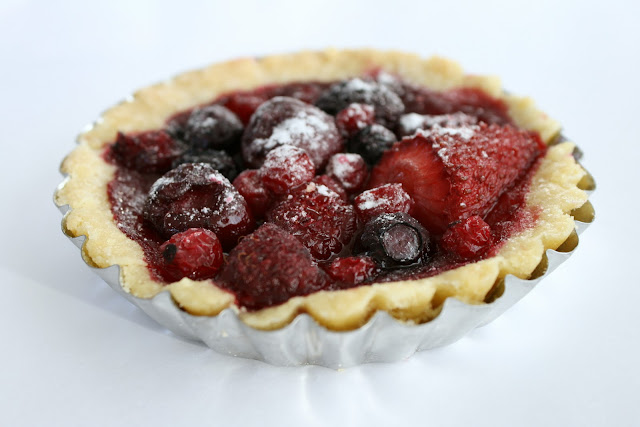
To make mine i used the first pasta frolla recipe and had it refrigerated over 1 night. The dough was a bit crumbly starting out filling my little tart pans, but it all ended well.
Made three different kind of crostata, first some with strawberry preserves, the second with frozen red fruit and the last one with fresh apple. I baked the apple a bit and mixed it up with sugar and cinnamon.
25 minutes of baking wasn't long enough for this little crostata, the ones with the fruit needed 10 minutes of additional time.

The crostata really taste delicious! Simona thank you for this great challenge!


These are the recipe's we had to use:

Version 1 of pasta frolla
Ingredients:

•1/2 c. minus 1 tablespoon [105 ml, 100 g, 3 ½ oz] superfine sugar (see Note 1) or a scant 3/4 cup [180ml, 90g, 3 oz] of powdered sugar
•1 and 3/4 cup [420 ml, 235 g, 8 1/4 oz.] unbleached all-purpose flour
•a pinch of salt
•1 stick [8 tablespoons / 4 oz. / 115 g] cold unsalted butter, cut into small pieces
•grated zest of half a lemon (you could also use vanilla sugar as an option, see Note 2)
•1 large egg and 1 large egg yolk, lightly beaten in a small bowl
Note 1: Superfine sugar is often also referred to as ultrafine, baker’s sugar or caster sugar. It’s available in most supermarkets. If you cannot find “superfine” sugar, you can make your own by putting some regular granulated sugar in a food processor or blender and letting it run until the sugar is finely ground.

Note 2: There are different ways of making vanilla sugar. I keep vanilla beans in a jar half-filled with sugar until I need to use them, for example, to make vanilla ice cream. After I remove the split bean from the custard that will go into the ice cream maker, I rinse it, dry it and put it back in the jar with sugar.

Making pasta frolla by hand:

1.Whisk together sugar, flour and salt in a bowl.
2.Rub or cut the butter into the flour until the mixture has the consistency of coarse crumbs. You can do this in the bowl or on your work surface, using your fingertips or an implement of choice.
3.Make a well in the center of the mounded flour and butter mixture and pour the beaten eggs into it (reserve about a teaspoon of the egg mixture for glazing purposes later on – place in the refrigerator, covered, until ready to use).
4.Add the lemon zest to your flour/butter/egg mixture.
5.Use a fork to incorporate the liquid into the solid ingredients, and then use your fingertips.
6.Knead lightly just until the dough comes together into a ball.
7.Shape the dough into a flat disk and wrap in plastic wrap. Place the dough in the refrigerator and chill for at least two hours. You can refrigerate the dough overnight.

Making pasta frolla with a food processor:


1.Put sugar, flour, salt, and lemon zest in the food processor and pulse a few times to mix.
2.Add butter and pulse a few times, until the mixture has the consistency of coarse meal.
3.Empty food processor's bowl onto your work surface
4.See step 3 above and continue as explained in the following steps (minus the lemon zest, which you have already added).
Variation for Version 1 of pasta frolla:

If you want, you can make the pasta frolla using a combination of all-purpose flour and whole-wheat pastry flour.

If you choose to try this variation, use 1 cup [240 ml, 135 g, 4 3/4 oz.] unbleached all-purpose flour and 3/4 cup [180 ml, 100 g, 3.5 oz.] whole-wheat pastry flour.

Version 2 of pasta frolla

In this version of pasta frolla, I have played with different kinds of flours, using almond, whole-grain barley and, most recently, coconut flour instead of some of the all-purpose flour. If you want to try a different version of pasta frolla that uses some flours that you wouldn’t normally use, this is a good recipe to try. All the flours listed below (whole-wheat pastry, almond flour, coconut flour and barley flour) are available at health food stores. You may even find them at well-stocked supermarkets.

The preparation for this version of pasta frolla is very similar to the preparation for Version 1.

Ingredients

•1/3 cup [80 ml, 75 g, 2 2/3 oz.] superfine sugar or 1/2 cup [120ml, 60 g, 2 oz]powdered sugar (see Note 1.)
•1/2 cup [120 ml, 65 g, 2 3/8 oz.] unbleached all-purpose flour
•1/2 cup [120ml, 65 g. 2 1/4 oz.] whole-wheat pastry flour
•1/4 cup [60ml, 28 g, 1 oz] almond flour, or almond meal, or coconut flour
•1/4 cup [60ml, 28 g, 1 oz.] whole-grain barley flour or unbleached all-purpose flour
•a pinch of salt
•6 tablespoons[90ml, 85 g, 3 oz] cold unsalted butter, cut into small pieces
•1 large egg, lightly beaten
•1/4 teaspoon vanilla extract (you can also use vanilla sugar; see Note 2.)
Note 1: Superfine sugar is often also referred to as ultrafine, baker’s sugar or caster sugar. It’s available in most supermarkets. If you cannot find “superfine” sugar, you can make your own by putting some regular granulated sugar in a food processor or blender and letting it run until the sugar is finely ground.

Note 2: There are different ways of making vanilla sugar. I keep vanilla beans in a jar half-filled with sugar until I need to use them, for example, to make vanilla ice cream. After I remove the split bean from the custard that will go into the ice cream maker, I rinse it, dry it and put it back in the jar with sugar.

Directions:

By hand:

1.Whisk together sugar, flours and salt in a bowl.
2.Rub or cut the butter into the sugar and flour mixture until it has the consistency of coarse crumbs. You can do this in the bowl or on your work surface, using your fingertips or an implement of choice.
3.Make a well in the center of the flour and butter mixture and pour the beaten egg and vanilla extract into it.
4.Use a fork to incorporate the liquid into mixture and then use your fingertips.
5.Knead lightly just until the dough comes together into a ball.
6.Shape the dough into a flat disk and wrap in plastic wrap. Place the dough in the refrigerator and chill for at least two hours. You can refrigerate the dough overnight.
With a food processor:

1.Put sugar, flour, and salt in the bowl of the food processor and pulse a few times to mix.
2.Add butter and pulse a few times until the mixture has the consistency of coarse meal.
3.Empty food processor's bowl onto your work surface.
4.Make a well in the center of the mounded flour and butter mixture and pour the beaten egg and vanilla extract into it.
5.Use a fork to incorporate the liquid into the solid ingredients then use your fingertips.
6.Knead lightly just until the dough comes together into a ball.
7.Shape the dough into a flat disk and wrap in plastic wrap. Place the dough in the refrigerator and chill for at least two hours. You can refrigerate the dough overnight.


Ideas for Filling for Your Crostata
Whether you choose to make Version 1 or 2 of the pasta frolla, there are numerous fillings that you can choose from for your crostata. I am suggesting some filling for you here (and including assemblage and baking instructions). But be brave and creative and see what you can come up with!

Crostata di Marmellata (crostata with a jam filling using Version 1 pasta frolla)

If you choose to make a crostata with a jam filling, you will need:

•1 and 3/4 cups [415ml, 600 gm, 21 oz] of jam or fruit preserves, whatever flavor you like (Note: I use my homemade fruit preserves, which have a low sugar content. I recommend you choose a good quality product, made with mostly fruit.)
Assembling and baking the crostata di marmellata:

1.Heat the oven to 375ºF [190ºC/gas mark 5].
2.Take the pasta frolla out of the fridge, unwrap it and cut away ¼ of the dough. Reserve this dough to make the lattice top of the crostata. Refrigerate this dough while you work on the tart base.
3.To help roll the crostata dough, keep the dough on top of the plastic wrap that you had it wrapped in. This can help rolling the dough and can also help when transferring the dough to your pan. You can also use parchment paper for this. However, you can also roll the dough directly on a work surface if you prefer.
4.Lightly dust the top of the dough and your work surface (if you’re rolling directly on a work surface) with flour. Keep some flour handy to dust the dough as you go along.
5.If the dough is very firm, start by pressing the dough with the rolling pin from the middle to each end, moving the rolling pin by a pin's width each time; turn the dough 180 degrees and repeat; when it softens, start rolling.
6.Roll the dough into a circle about 1/8th inch (3 mm) thick.
7.If you used the plastic wrap or parchment paper as rolling surface, flip dough over the pan, centering it, and delicately press it all around so the corners are well covered. Peel away the plastic wrap.
8.Trim the excess dough hanging over the edges of the pan. Press the remaining dough around the border into the sides of the pan making sure the border is an even thickness all the way around.
9.Prick the bottom of the dough with a fork in several places.
10.Take out of the fridge the reserved pasta frolla you had cut away earlier. Roll it with your pin and cut into strips or use cookie cutters to make small shapes (this is not traditional, but it looks cute); or roll with your hands into ropes.
11.Spread the jam or fruit preserves evenly over the bottom of the crostata.
12.Use the prepared strips or rolls of dough to make a lattice over the surface, or decorate with the cut shapes. (Note: You can use dough scraps to make cookies: see the Additional Information section for some pointers)
13.Brush the border and strips of dough with the reserved beaten eggs. You can add a drop or two of water to the beaten eggs if you don’t have enough liquid.
14.Put the tart in the oven and bake for 25 minutes.
15.After 25 minutes, check the tart and continue baking until the tart is of a nice golden hue. (Note: Every oven is different. In my oven it took 34 minutes to bake the tart until golden.)
16.When done, remove the tart from the oven and let cool. If you have used a tart pan with a removable bottom, then release the tart base from the fluted tart ring. Make sure the tart is completely cool before slicing and serving.


maandag 22 november 2010

Spaghetti with Arugula Pesto and Seared Jumbo Shrimp for IHCC


I've been missing out of last weeks fall theme, but back here with this weeks potluck at IHCC.

My boyfriend has been asking about shrimps so when i came across this recipe, i thougt this would be a delicious simple weeknight meal.
He really loved my choice because he saw no veggies(he isn't a big fan of them), but ofcourse there is already a lot of arugula in the sauce/ pesto. Seems like a great choice to me to! No complaining about the veggies he didn't like because he didn't regonized them.

recipe from foodnetwork.com
Cook time: 15 minutes
yields: 6 servings

Ingredients
2 cups fresh arugula
1 garlic clove
1/2 cup plus 2 tablespoons olive oil
1/2 cup freshly grated Parmesan
Salt and freshly ground black pepper
1 pound jumbo shrimp
1 pound spaghetti
Lemon zest, for garnish
10 parsley leaves, chopped, for garnish

Directions
Blend the arugula and garlic in a food processor until finely chopped. With the machine running, gradually add 1/2 cup of oil, processing until well blended. Transfer the pesto to a large bowl. Stir in the Parmesan. Season with salt and pepper, to taste.

Prepare the grill (high heat). Using a knife, cut the back of the shrimp. Brush the shrimp with oil. Sprinkle with salt. Grill the shrimp until just cooked through, about 3 minutes per side. Transfer the shrimp to a plate.

Meanwhile, cook the pasta in a large pot of boiling salted water until tender but still firm to the bite, stirring occasionally, about 8 minutes. Drain, reserving 1/2 cup of the cooking liquid.

Toss the pasta with the pesto in the large bowl to coat, adding the reserved cooking liquid 1 tablespoon at a time to moisten. Top with the grilled shrimp. Garnish with the lemon zest and parsley.


zondag 14 november 2010

Daring cooks november 2010 Rise and shine: Soufflé


Dave and Linda from Monkeyshines in the Kitchen chose Soufflés as our November 2010 Daring Cooks’ Challenge! Dave and Linda provided two of their own delicious recipes plus a sinfully decadent chocolate soufflé recipe adapted from Gordon Ramsay’s recipe found at the BBC Good Food website.

I've been missing out on the daring cooks for several months now, but when i saw this challenge i was back in immediatly!
Exited bij the challenge as i am, i was already afraight of disapointment. Thats because i have never made souffle's before and i still think its difficult to make them.

The batter is easy and while they where in my oven they did rise but as soon as i took them out the souffle start collapsing...
That was where i was afraight for but they still where delicious, i'm not intimidaded anymore and going to try some again. Thanks for this great challenge!

Ingredients

FOR THE DISHES

2 Tbsp (30 ml) 1 oz (30g) unsalted butter, for greasing
Cocoa powder or finely grated chocolate

FOR THE CREME PATISSERIE

2 tbsp (30 ml) (18 gm) (2/3 oz) plain (all-purpose) flour
2 tsp (10 gm) (0.35 oz) caster (superfine) sugar (regular sugar is OK)
½ tsp (4½ gm) (0.15 oz) corn starch (aka cornflour)
1 medium egg yolk
1 medium whole egg
4 Tbsp (60 ml) milk
5 Tbsp (75 ml) heavy cream (or double cream)
3 oz (90gm) good-quality dark chocolate preferably 70+% cocoa solids, broken in pieces
2 Tbsp (30 ml) (15 gm) (½ oz) unsweetened cocoa powder
Optional: 2 tsp orange zest or 2 tsp minced chipotle chile en adobo or 1 tsp chipotle chile powder. (The chile version is a Monkeyshines favorite!) Optional: powdered sugar for dusting

FOR THE EGG WHITES

6 medium egg whites
6½ Tbsp (95 ml) 3 oz (90g) superfine/caster sugar (if you don’t have it, regular sugar is OK)

Directions:

1. Heat oven to moderate 375 ˚F/190 ˚C/gas mark 5.
2. Take four 1 cup/~240ml soufflé dishes and brush them completely with softened butter. Tip a little cocoa powder or grated chocolate into each dish, roll the dish around tilting it as you do so it is evenly lined all round.
3. For the crème patisserie, mix the flour, sugar and corn starch into a small bowl. Put egg yolk and whole egg into a medium sized bowl, beat lightly, then beat in half of the flour mixture to give a smooth paste. Tip in the rest of the flour mixture and cocoa powder and mix well.
4. To make the ganache, pour the milk and cream into a pan and bring just to the boil. Remove from the heat. Add the chocolate and beat until it is melted and smooth with no lumps.
5. Gradually stir hot chocolate ganache into the paste from step 3, and add the orange zest or chile if using. This is your crème patisserie.
6. Whisk the egg whites to soft peaks with an electric whisk. Sprinkle in the sugar as you are mixing. Keep whisking to give stiff, firm peaks to give volume to
7. Stir about 2 tbsp (30 ml) of the beaten egg whites into the crème patisserie. Carefully fold in a third of the rest, cutting through the mixture. Fold in another third (take care not to lose the volume), then fold in the rest.
8. Spoon the mixture into the dishes. Run a spoon across the top of each dish so the mixture is completely flat. Take a little time to wipe any splashes off the outside of each dish, or they will burn on while cooking.
9. Bake the soufflés for 15-17 minutes.
10. The soufflés should have risen by about two thirds of their original height and jiggle when moved, but be set on top.


zaterdag 13 november 2010

Rice Pudding with Vanilla Bean, Orange and Rum for IHCC


This weeks theme at IHCC is kid at heart.
As a kid i was fond of rice pudding, so made this delicious recipe.
i left out the rum, cause i don't like that.

Recipe from foodnetwork.com
Cook time: 35 minutes
Yields: 4 to 6 servings

Ingredients
5 cups whole milk
2/3 cup Arborio rice or other short-grain white rice
1 vanilla bean, split lengthwise
1/2 cup sugar
2 teaspoons dark rum
1 teaspoon grated orange peel
Orange segments


Directions
Combine the milk and rice in a heavy medium saucepan. Scrape in the seeds from the vanilla bean; add the bean. Bring the milk to a boil. Reduce the heat to medium and simmer until the rice is tender, stirring frequently, about 25 minutes. Mix in the sugar, rum, and orange peel. Discard the vanilla bean. Cook until the mixture thickens, 5 to10 minutes longer.

Spoon the rice pudding into bowls. Cover and refrigerate until cold, about 5 hours. Serve with orange segments.